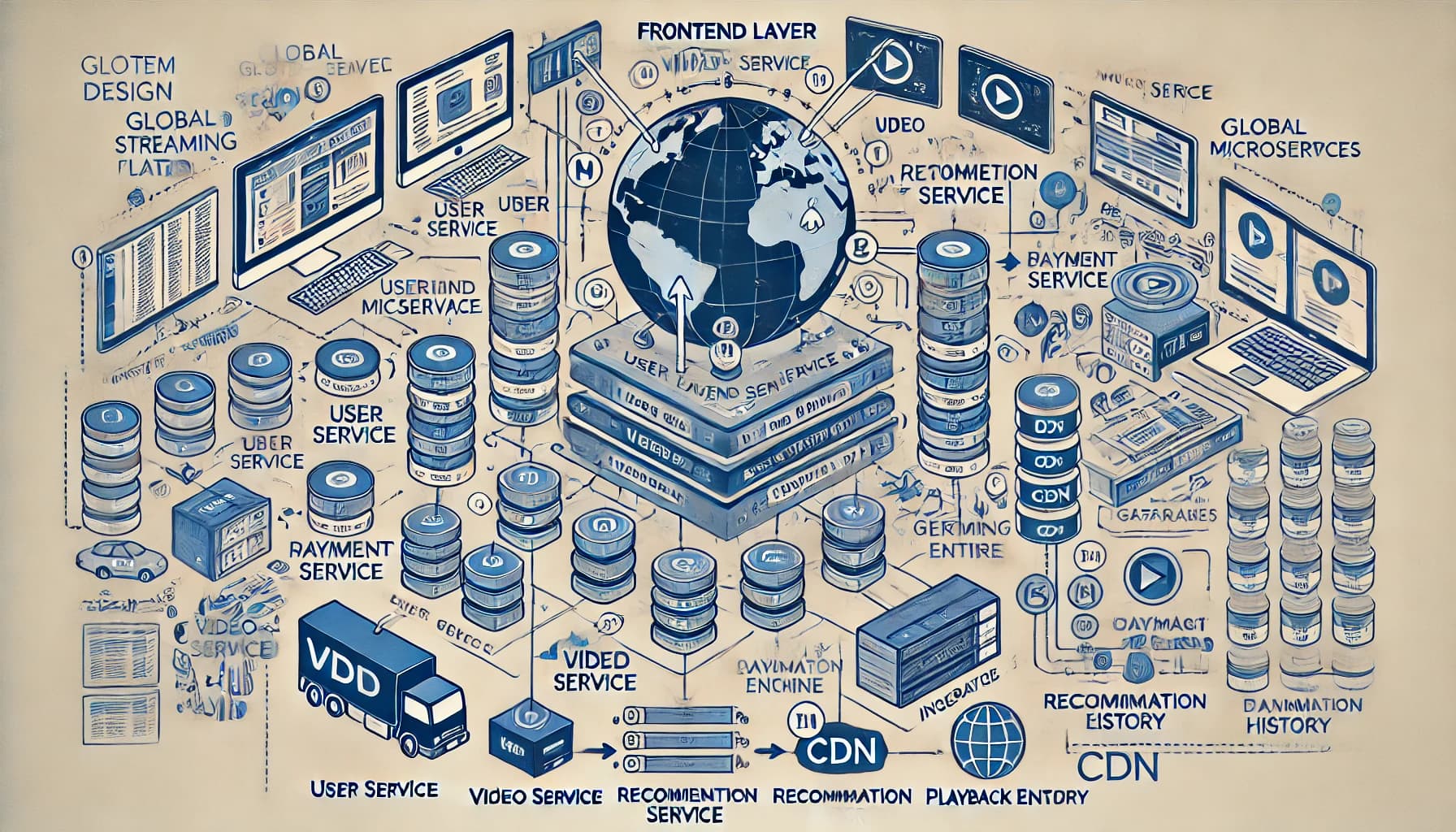
Advanced System Design for a Complex Product: Global Video Streaming Platform
I am a seasoned tech professional with experience in various technology roles and startups. My expertise spans system design, as well as the development of innovative frameworks and servers that drive scalable and efficient solutions. I am passionate about architecting robust systems and thrive in dynamic environments where innovation, problem-solving, and technical excellence are paramount. Alongside my technical work, I also write about life motivation — sharing thoughts that inspire reflection, resilience, and personal growth.
Let’s design a system for a globally scaled video streaming platform like Netflix. This platform allows users to stream high-quality video content on-demand, supports millions of concurrent users, and ensures low-latency playback with adaptive streaming.
1. Problem Statement
Build a globally distributed video streaming platform with the following requirements:
Functional Requirements:
Users can register, log in, and manage profiles.
Search and recommendation engine for personalized content.
Streaming high-definition (HD) videos with adaptive bitrate.
Secure playback with DRM (Digital Rights Management).
Support for multiple devices and platforms.
Non-Functional Requirements:
High availability with 99.99% uptime.
Low latency playback worldwide.
Scalable to support millions of users.
Data integrity and consistency for user profiles, subscriptions, and video metadata.
2. High-Level System Architecture
Core Components:
Frontend:
Web and mobile apps for different platforms (Android, iOS, Smart TVs, etc.).
Lightweight and responsive UI to handle different screen sizes.
Backend:
User Service: Handles user registration, authentication, and profile management.
Video Service: Manages video metadata (e.g., title, description, categories).
Streaming Service: Handles video playback, adaptive bitrate, and caching.
Recommendation Engine: Provides personalized recommendations.
Payment Service: Handles subscriptions and payments.
Database Layer:
Relational Database (RDS): For structured data like user profiles and subscriptions.
NoSQL Database: For unstructured data like video metadata and recommendations.
Content Delivery Network (CDN):
- Distributes video content globally for low-latency playback.
Third-Party Integrations:
DRM service for secure playback.
Payment gateways like Stripe or PayPal.
Analytics platforms for usage tracking.
3. Detailed Components and Workflow
A. User Authentication
Use OAuth 2.0 for secure login via email, social accounts, or Single Sign-On (SSO).
Store hashed passwords using bcrypt or Argon2 in a secure database.
B. Video Storage and Processing
Storage:
- Use Amazon S3 or Google Cloud Storage for raw video uploads.
Processing:
Transcode videos into multiple resolutions (e.g., 240p, 480p, 1080p) using tools like FFmpeg.
Store transcoded videos in a distributed object store like AWS S3.
C. Adaptive Bitrate Streaming
Split videos into smaller chunks (e.g., 5-second segments).
Encode each chunk at different bitrates for adaptive streaming (HLS/DASH protocols).
Use a manifest file to tell the player which video chunks to request based on network conditions.
D. CDN Integration
Use a globally distributed CDN (e.g., Akamai, Cloudflare, or AWS CloudFront) to cache video content near users.
Pre-cache popular videos in edge servers for instant playback.
E. Recommendation Engine
Data Collection:
- Track user behavior (e.g., watch history, likes, and search patterns).
Algorithm:
- Use collaborative filtering (similar user preferences) and content-based filtering (based on metadata).
Storage:
- Store recommendations in a NoSQL database like Cassandra for fast access.
F. Payment Service
Integrate with secure payment gateways.
Use idempotent APIs to avoid duplicate charges.
Send transaction logs to a financial system for auditing.
G. Real-Time Analytics
Use a data pipeline (e.g., Kafka) to collect streaming metrics (buffering events, bitrate changes, etc.).
Store metrics in a data warehouse (e.g., Snowflake) for reporting.
4. Database Design
Relational Database: (PostgreSQL)
Users Table: Stores user profiles.
Subscriptions Table: Tracks active subscriptions.
Videos Table: Contains metadata for all videos.
NoSQL Database: (Cassandra)
Recommendations Table: Key-value store for user recommendations.
Playback History Table: Stores playback progress and history.
5. Scalability and Reliability
Horizontal Scaling:
Deploy backend services in Kubernetes clusters.
Use auto-scaling groups to handle traffic spikes.
Load Balancing:
- Use Elastic Load Balancers to distribute traffic across servers.
Database Sharding:
- Partition user data by region to reduce latency.
Disaster Recovery:
Implement multi-region data replication.
Use regular backups and restore mechanisms.
6. Security
Data Encryption: Encrypt sensitive data (e.g., user credentials, payment info).
DRM: Secure video playback to prevent unauthorized copying.
Access Controls: Implement role-based access controls for internal services.
7. Example Workflow: Video Playback
User Interaction:
- User searches for a video and clicks "Play."
Backend Processing:
The app sends a request to the Video Service.
The service retrieves video metadata from the database.
Streaming Setup:
The service selects the closest CDN edge server.
The CDN serves the video manifest file to the user.
Video Playback:
The player requests video chunks dynamically based on network speed.
The chunks are streamed from the CDN to the user.